Best App to Remember Medication (That Actually Proves You Took It)
Most medication reminder apps tell you to take your pills. Habpic is the only one that asks you to prove it. Here's why that difference changes everything.
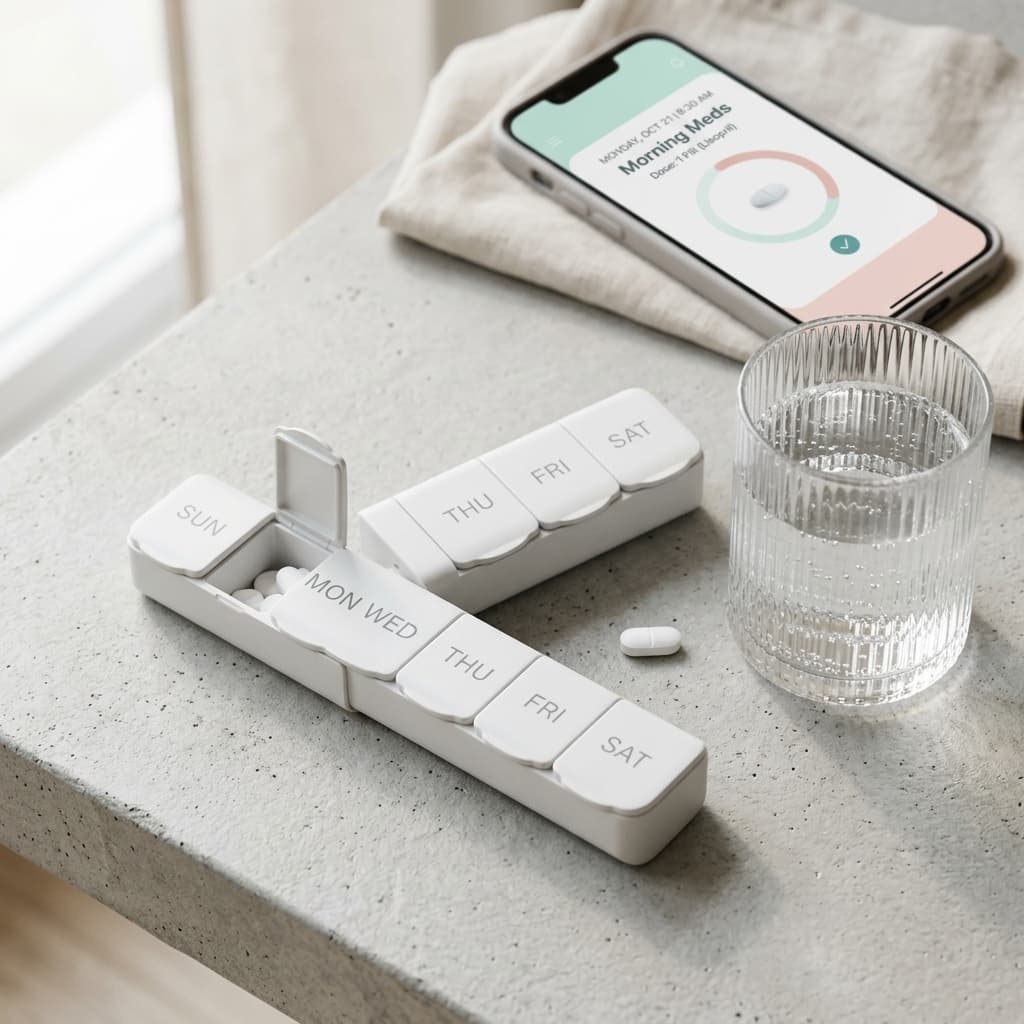
The Best App to Remember Medication Isn't One That Reminds You — It's One That Proves You Did
Most medication reminder apps have the same problem: they remind you, you dismiss the notification, and twenty minutes later you can't remember whether you actually took your medication or just dismissed the alert.
That gap — between the reminder and the certainty — is the real problem nobody is solving.
This article breaks down why traditional medication reminders fail, what the science says about memory and health habits, and why a photo-based approach is the closest thing to a reliable answer to the question everyone with a daily medication routine has asked: did I actually take it today?
Why Medication Reminders Fail (Even When You're Trying)
Here's what a typical medication reminder loop looks like:
Your alarm goes off. You're in the middle of something — a meeting, a conversation, making breakfast. You swipe the notification away thinking "I'll do it in two minutes." The two minutes pass. An hour later, you have no idea whether you took your medication or just silenced the alert.
This isn't carelessness. It's neuroscience.
Prospective memory — the cognitive function that handles "remember to do X in the future" — is one of the most fragile memory systems in the human brain. Unlike retrospective memory (recalling the past), prospective memory is highly vulnerable to distraction, context switching, and routine interference. When a behavior becomes habitual, the brain stops encoding it as a distinct event. You've taken the same pill at the same time for three years. Your brain has categorized it as background noise.
Psychologist Mark McDaniel, whose research on prospective memory at Washington University spans decades, has found that familiar, repetitive tasks are among the hardest to reliably remember — not because they're difficult, but because the brain stops paying attention to them.
A notification cannot fix this. A notification is itself a piece of prospective memory. You have to remember to act on it. You have to remember that acting on it means physically taking the medication, not just acknowledging the alert.
The problem isn't the reminder. The problem is verification.
Common Solutions (And Why They Fail)
Pill organizers
A physical pill organizer is genuinely useful — if you fill it correctly each week, and if you remember to check it. But checking an empty compartment tells you the pill is gone. It doesn't tell you whether you took it, or whether it fell on the floor, or whether someone else moved it. It's evidence, but it's weak evidence.
Standard reminder apps
Apps like Medisafe, MyTherapy, and Apple's built-in Health reminders are all built on the same architecture: schedule a notification → user acknowledges it → log it as taken. The problem is that the logging is manual and happens at the point of least cognitive reliability. You're logging while distracted, while rushing, while still uncertain whether you've already logged it.
Worse: studies on medication adherence consistently show that self-reported adherence is significantly higher than actual adherence. People believe they're taking their medication consistently because they remember meaning to. The intention and the action collapse into the same memory.
Alarm chains / multiple reminders
Some people respond to reminder failure by adding more reminders. This creates alarm fatigue — a well-documented phenomenon in clinical settings where nurses began ignoring monitor alarms because there were too many of them. The same thing happens in personal health. More alerts produce more dismissals, not more adherence.
A Better Approach: Verification Over Notification
What if the question wasn't "did you mean to take your medication?" but "can you prove that you did?"
This is a fundamentally different question, and it requires a fundamentally different tool.
The most reliable memory aid isn't a reminder — it's a record. A record that exists independently of your memory of creating it. One that you have to actively produce, in the moment, at the point of action.
This is how pilots do it. This is how surgeons do it. This is how any high-stakes, repetitive task with consequences gets handled in professional contexts: not with reminders, but with documentation.
Medication adherence is a high-stakes, repetitive task. The consequences of forgetting are real. The solution should match the problem.
How Habpic Solves This
Habpic is a habit tracker built on one rule: no photo, no proof.
You set up your medication as a daily habit. When it's time to take it, you open Habpic and take a photo — your pill, your hand, your glass of water, whatever makes sense to you. That photo is timestamped, logged, and added to your visual history.
Now you have an answer to the question that no reminder app can answer: did I take it today?
You open your grid. If there's a photo for today, you did. If there isn't, you didn't. There's no ambiguity. No uncertain memory. No second-guessing.
This is what makes Habpic different from every other medication reminder app on the market. It doesn't just notify you. It creates a verifiable record — and the act of creating that record is itself a reinforcement of the habit.
Why the photo matters psychologically
Taking a photo is an intentional act. You cannot accidentally photograph your medication. You cannot dismiss a camera prompt the way you can dismiss a notification. The physical and cognitive effort involved — unlocking your phone, opening the app, taking the picture — is enough to encode the action as a distinct memory event, rather than merging it with the background noise of routine.
Behavioral psychologists call this implementation intention combined with external memory cues. The photo serves as both the trigger and the record. You've made it harder to be uncertain.
The grid as accountability
Over time, Habpic builds a visual grid of your medication habit — a calendar of photos. This isn't just a log. It's a body of evidence. When your doctor asks about your adherence, you have something to show them. When you're having a hard week and wondering whether it's worth it to keep going, you can look at weeks of proof that you showed up. Identity isn't built through memory. It's built through evidence.
Real-World Example
Imagine you're managing a thyroid condition and take levothyroxine every morning. The dosage timing matters. You've been on it for two years. By now, the routine is so deeply grooved that it's essentially invisible to your memory.
On Tuesday morning, you take your pill while checking your phone. Or do you? You're not sure. You remember being in the kitchen. You remember checking your phone. Did the pill come before or after?
With a standard reminder app, you have no answer. You either take a second pill (potentially risky) or skip it (also risky). You're making a medical decision based on uncertain memory.
With Habpic, you open your grid. Tuesday's photo is there: your hand, your pill, your counter. You took it. You move on with your day.
That certainty has value that goes far beyond the cost of a thirty-second photo.
Benefits of Using Habpic for Medication
- Eliminates the "did I take it?" moment by replacing memory with visual evidence
- Builds a retrievable medical log you can reference at any time
- Reduces anxiety around medication adherence — especially for people managing multiple prescriptions
- Creates accountability without adding cognitive load (one photo, done)
- Builds over time into a meaningful record of your health commitment
- Works for caregivers, too — photograph medications for a family member and document it in real time
Frequently Asked Questions
Can Habpic remind me to take my medication? Yes. Habpic supports custom reminders tied to each habit. But unlike standard reminder apps, the reminder links directly to the photo log — so the notification isn't just asking you to remember, it's inviting you to prove.
What if I forget to take the photo? A missing photo is its own form of feedback. If you open Habpic at the end of the day and today's entry is empty, you have real information: either you didn't take your medication, or you took it and forgot to document it. Both are worth knowing.
Is Habpic designed specifically for medication? Habpic is a photo-based habit tracker built for any daily habit that matters. Medication is one of the most common and highest-stakes use cases — which is why it works so well here.
How private is my medication data? Your photos live on your device. Habpic doesn't share your health data with third parties.
Can I share my medication log with a doctor? You can screenshot or export your grid to share with a healthcare provider as a visual adherence record.
Is Habpic available on both iOS and Android? Yes — Habpic is available on both platforms.
Final Thoughts
The best app to remember medication isn't the one with the loudest alarm or the most customizable notification schedule. It's the one that transforms an uncertain memory into an undeniable record.
Reminders assume you'll remember to act on them. Habpic assumes you need proof — and then gives you a system to create it.
If you've ever stood in your kitchen at noon wondering whether you took your morning pill, you already understand the problem. The solution isn't another alert. It's a photograph.
[Download Habpic and turn your daily medication into a documented habit.]
Prove your progress.
Simplify your routine, clear your mind, and finally prove to yourself that you can change. Join our waitlist now to bridge the gap between inspiration and action.
 Download for iOS
 Download for Android