How to Stay Consistent With Exercise Habits (When Motivation Always Runs Out)
Motivation is temporary. Identity is permanent. Here's the science behind building exercise consistency that doesn't depend on how you feel — and the one tool that makes it visible.
How to Stay Consistent With Exercise Habits (When Motivation Always Runs Out)
Every January, millions of people start working out. By February, most of them have stopped.
This isn't a discipline problem. It's a misunderstanding of what makes habits sustainable. Most people try to stay consistent with exercise using the same fuel that started it: motivation. But motivation is designed to initiate behavior, not maintain it. It rises in response to a compelling vision and falls the moment life gets complicated.
The people who stay consistent with exercise for years — through bad weeks, travel, illness, life upheaval — are not more motivated than everyone else. They've built a system that doesn't depend on motivation. And increasingly, they're using visual proof to make that system stick.
Why This Problem Exists
Behavioral scientists define two types of motivation: intrinsic (doing something because of how it makes you feel internally) and extrinsic (doing something for an external reward or to avoid punishment). Most fitness apps are built almost entirely on extrinsic motivation — streaks, badges, points, leaderboards. When the rewards stop feeling rewarding, the behavior stops.
But there's a deeper issue: exercise is a habit whose benefits are slow and whose costs are immediate. Every morning you wake up for a run, the bed is warm now. The endorphins come later. The better body composition comes months later. The human brain is not built to reliably choose delayed reward over immediate comfort. This is what neuroscientists call hyperbolic discounting — we systemically undervalue future rewards relative to present ones.
Motivation can override this in the short term. Habit can override it indefinitely — but only once the neural pathways for the behavior are deep enough. Building those pathways requires consistent repetition before the feeling of motivation arrives naturally. There's a gap between starting and the behavior becoming self-sustaining. That gap is where most people quit.
Common Solutions (And Why They Fail)
Finding a workout buddy
Social accountability is one of the most well-studied consistency tools in exercise science. It works. But it's also fragile — schedules diverge, motivation asymmetry creates guilt, and the moment your buddy stops, your reason to show up disappears with them.
Setting fitness goals
Goals create initial direction but poor long-term momentum. Once you reach the goal (or fail to), the motivation tied to it dissolves. James Clear's research popularized the insight that systems beat goals — because goals tell you where to go, but systems are what actually get you there repeatedly.
Fitness apps with gamification
Tracking workouts in apps like Strava, Nike Run Club, or Fitbit creates useful data and community pressure. But gamification layers — achievements, leaderboards, challenges — are motivational scaffolding, not habits. They make the behavior feel more urgent without changing its underlying neural architecture.
Willpower
Willpower is a finite resource that depletes across the day (a phenomenon psychologists call ego depletion, though the research is more nuanced than the pop-science version). Relying on willpower to get to the gym is a strategy that works until it doesn't — which is usually when you need it most.
A Better Approach: Identity-Based Exercise Consistency
The most durable exercise consistency isn't built on motivation, goals, or willpower. It's built on identity.
Psychologist James Clear articulates this clearly: every action you take is a vote for the type of person you want to be. Miss a workout and you vote against the identity. Show up and you vote for it. Over thousands of reps, the vote tally becomes who you are.
But identity is abstract. What makes it concrete is evidence.
When you can look at a visible record of times you showed up — real proof, not a number, but actual documentation of your effort — your identity as someone who exercises stops being a wish and becomes a fact. And facts are harder to abandon than intentions.
This is where visual proof becomes not just motivating but structurally important. The evidence is the mechanism, not the reward.
How Habpic Solves This
Habpic is not a fitness tracker. It doesn't count your reps, measure your heart rate, or analyze your splits. It does one thing: it asks you to photograph your workout, and it builds that evidence into a visual grid over time.
That distinction matters enormously.
Fitness trackers tell you what you did. Habpic shows you who you are.
The daily proof mechanic
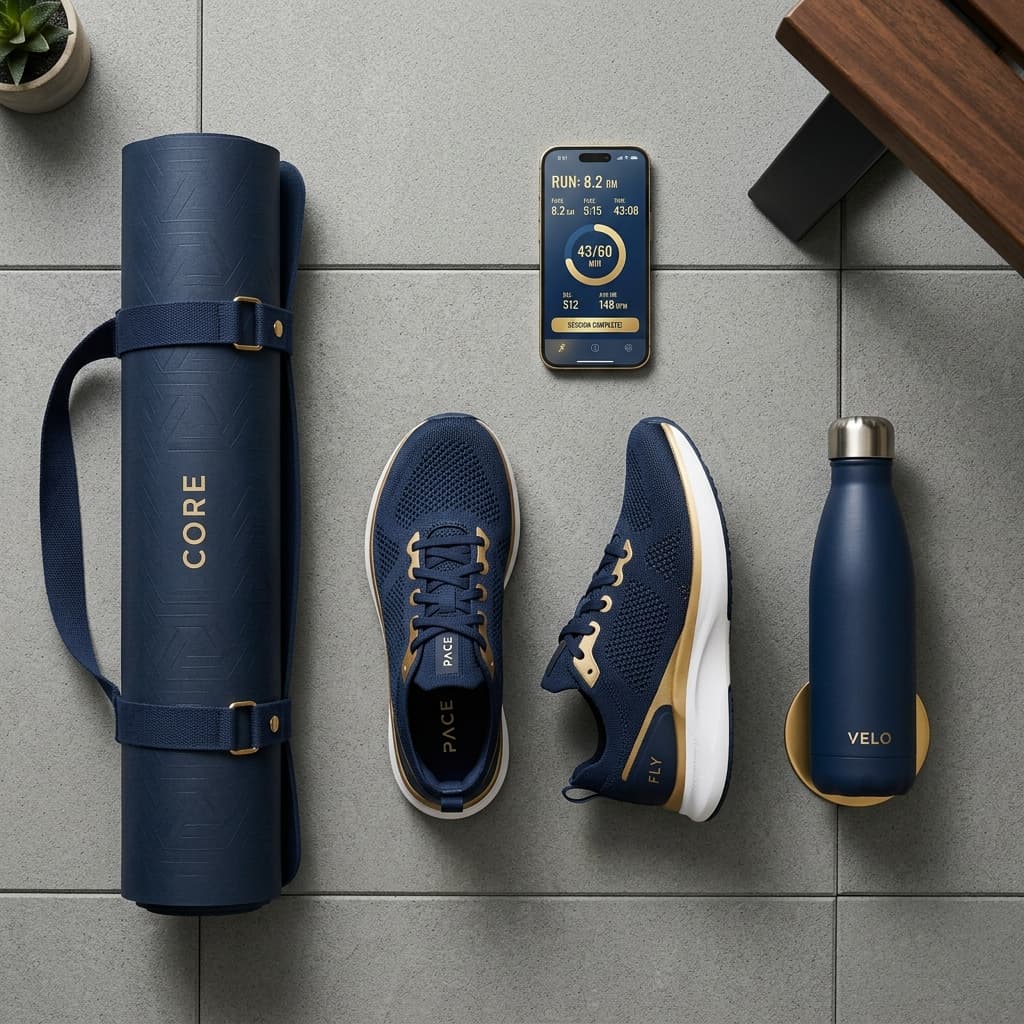
When you mark a workout complete in Habpic, you take a photo. Your shoes lined up before the run. Your mat after the session. A sweaty selfie. The gym parking lot at 6:15 a.m. These are your votes. Each photo is timestamped and added to your grid.
Over two months, you have a grid of real evidence. You can see the weeks you crushed it. You can see the gap the week you had the flu. You can see the bounce-back. It's not a narrative you're telling yourself — it's a record you created one photo at a time.
Why this changes the identity equation
When you're staring at your alarm at 5:55 a.m. wondering whether to get up, the question isn't "do I feel motivated today?" The question is: "do I want there to be a photo here or a gap?"
That's a different question. It's concrete. It's about evidence, not feeling. And for many people, it's enough.
Breaking the motivation dependency cycle
Most people's relationship with exercise looks like this: motivated → consistent → life happens → inconsistent → guilt → recommit → motivated again. A wave. Every time the wave crashes, they have to rebuild from zero.
Habpic doesn't break this cycle. But it makes the evidence survive the cycle. Even when motivation drops, the grid is still there. When you come back after a hard week, you come back to your actual history — not a blank slate. The identity doesn't reset.
Real-World Example
Imagine two people both decide to build a morning run habit.
The first uses a standard fitness app. She logs her runs, builds a streak, feels great for three weeks. Then she gets sick for five days. The streak resets to zero. When she recovers, she opens the app and sees nothing — a blank slate. She has to emotionally recommit from scratch, and the activation energy required is higher because the evidence of her previous effort is buried in history charts.
The second uses Habpic. She photographs her runs. Gets sick for five days. When she recovers and opens the app, she sees weeks of photos and five empty days. The contrast is immediate: look at everything I built, and look at this short interruption. The evidence of who she is survived the break. The question isn't "can I start again?" — it's "which day do I add the next photo?"
The return is easier because the identity survived the interruption.
Benefits of Using Habpic for Exercise Consistency
- Evidence accumulates across weeks and months — motivation doesn't have to
- Identity is built visually — a photo grid is a stronger self-image reinforcement than a streak number
- No punishment for gaps — missed days are visible without resetting everything
- Works alongside any fitness tracker — Habpic is the accountability layer, not the measurement layer
- Reduces decision fatigue — "will I or won't I?" becomes "will I have a photo here or a gap?"
- Progress visible in the most human sense — not data charts, but actual moments
Frequently Asked Questions
Can I use Habpic alongside my fitness app? Absolutely. Habpic is not a replacement for tracking distance, pace, or strength metrics. It's the accountability layer — the proof that you showed up. Many people use it alongside Strava, Apple Fitness, or a training app.
What if I'm a beginner and my workouts feel embarrassing to photograph? The photos are for you, not anyone else. Your starting point is part of the record. Beginners who have photos from day one have something nobody else can buy: genuine evidence of where they started.
Does Habpic support different workout types? Yes. You can create separate habits for different workout types — running, lifting, yoga, cycling — each with its own photo grid.
What counts as a "good enough" photo? There are no rules. A photo of your shoes before you leave the house counts. So does a post-workout selfie. The standard is yours.
Is Habpic better than a fitness tracker for consistency? Fitness trackers measure what you do. Habpic documents that you did it. They answer different questions. For consistency specifically — showing up day after day — visual proof has a psychological advantage that metrics alone can't replicate.
Final Thoughts
Motivation is not a consistency strategy. It's a starting fuel — renewable but not continuous. Building exercise habits that last requires something that doesn't depend on how you feel on any given morning.
Identity does that. And identity is built from evidence.
A photo grid of your real workouts — imperfect, human, sometimes gapped, always honest — is one of the most powerful consistency tools you can hold in your hand.
Not because it makes exercise easier. But because it makes you undeniable.
[Build an exercise record you can't fake with Habpic.]
Prove your progress.
Simplify your routine, clear your mind, and finally prove to yourself that you can change. Join our waitlist now to bridge the gap between inspiration and action.
 Download for iOS
 Download for Android